
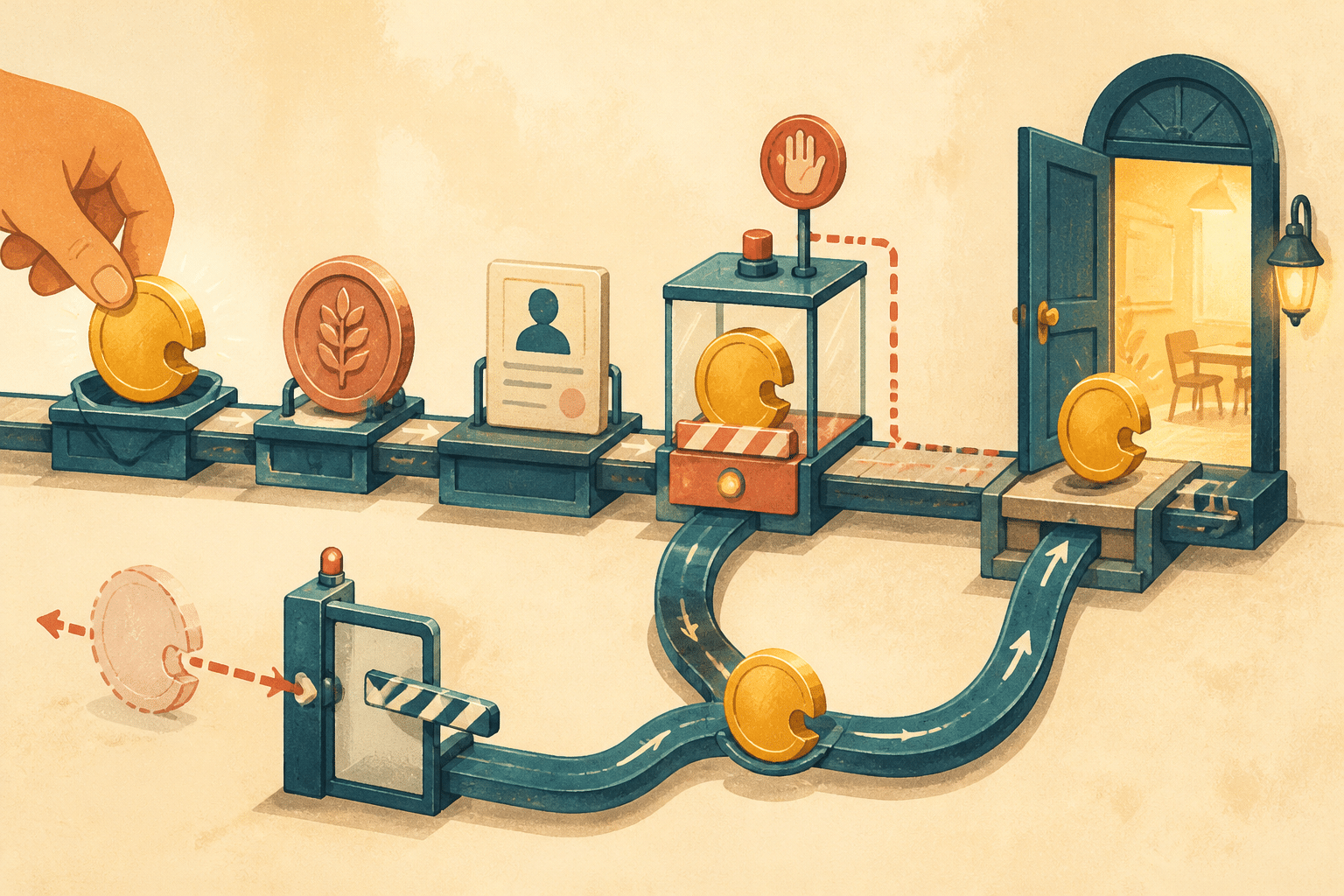

Someone pays for your course and, hours later, gets an email asking them to recover the cart they abandoned. Message suppression should prevent that contradiction, but adding another condition does not always solve the problem. The checkout, payment system, and email or WhatsApp tools may update at different times. That is why you need to define which system confirms the purchase and how that change stops each pending communication.
This article focuses on why message suppression can fail when payment events arrive late, are duplicated, or race with a scheduled send. For the lifecycle rule that changes a customer’s purchase status and triggers the right next message, see Purchase status: prevent messages after payment.
Message suppression: the problem isn’t always with sending
The journey seems simple: someone starts the payment process, abandons it, and enters an abandoned-cart sequence. If they complete the purchase later, they should exit that sequence. However, the message may already have been scheduled before the email platform received confirmation. The payment event may also arrive late, be processed twice, or fail to update the status WhatsApp checks.
It helps to distinguish three kinds of failure. A synchronization delay means the purchase is confirmed, but another tool does not know it yet. A race condition, on the other hand, occurs when the purchase and the message send are processed at nearly the same time. The system may check the status before receiving the update. Also, if each platform keeps its own version of who has purchased, there is no shared source of truth. In these cases, the main problem is not necessarily that the message was sent incorrectly.
Define which event confirms the purchase
First, agree on what “purchased” means in your business. Starting checkout or attempting a payment does not always mean a transaction is complete. For example, if you accept bank transfers, a payment may remain pending. The system that authoritatively records the order status should be the reference for deciding who remains eligible to receive recovery messages.
Next, pass the confirmation on to the channels with scheduled communications. Don’t assume that removing someone from a list cancels a message that is already in a send queue. The rule should invalidate pending messages and, whenever possible, check the purchase status again immediately before sending. This reduces the window in which a delayed update can trigger an untimely communication.
Map the path from checkout to message
Use the NEXO Method to review the journey from abandonment to payment. Write down which event starts each email or WhatsApp sequence, how long it waits, and which system can cancel it. Include bank transfers or other payment methods that remain pending so you don’t treat an attempted payment as a completed purchase.

Then identify which system owns the purchase status and how the update reaches each channel. Email might exclude a contact based on a CRM field while WhatsApp checks the checkout record; compare both rules and the timestamps from an actual case. If notifications can be retried, make the update safe to process twice so a duplicate event does not create a second enrollment.
Set one shared suppression rule: confirmed payment cancels pending recovery messages. Add a final status check before sending and decide who receives an alert when the status cannot be verified. Test a completed payment, a pending transfer, a duplicate notification, and a late confirmation in both channels. For recovery when an integration fails, see the guide to robust integrations and flow recovery.
Check what stops each communication
The practical decision is clear: audit which event stops each email and WhatsApp message, and verify it with test purchases. If a channel depends on another platform updating a tag, find out how long that change can take and what happens if it fails. This will tell you whether a confirmed purchase invalidates recovery messages across all channels, even when events arrive at different speeds.
A student who has already paid shouldn’t have to prove it by replying to an abandoned-cart message. Build this protection into the purchase flow to protect the student’s trust and keep your team from having to put out communication fires.